
Category
Date
Author
What Stayed With Us
Kassandra Valdivia
The Sydney Opera House is so embedded in our visual memory that it’s difficult to imagine the harbour without it. Its form is instantly recognisable; the uncertainty behind it, much less so.
What we know now as one of the world’s most recognisable buildings emerged through a process that was far from resolved: technical problems, changing solutions, escalating costs, political pressure and eventually, the departure of its architect before the building was complete.
Danish architect Jørn Utzon won the international competition to design the Opera House in 1957. His proposal was striking, but it was also incomplete. The sweeping forms of the roof were central to the design, yet exactly how they would be constructed hadn’t been solved.
Today, the shells feel inseparable from the Opera House, yet for several years they existed more convincingly as an idea than as something that could actually be built.
Utzon worked with the engineering firm Ove Arup & Partners through a succession of possible geometries. The breakthrough came with what became known as the Spherical Solution: deriving the different roof shells from sections of the same sphere. This meant their curved concrete ribs could be produced through a repeatable system rather than each requiring its own construction method.
The solution found the structure that allowed Utzon’s proposal to exist.
The shells are covered in more than a million tiles, alternating between glazed white and matte cream. As the light moves across them, their surface shifts too. Sometimes bright and reflective, elsewhere softer and almost shadowed.
In person, they’re less uniformly white than their familiar silhouette suggests. There’s texture and variation to something we tend to remember as a single, clean form.
The broad Monumental Steps presented another problem. Building them conventionally could have required rows of columns beneath. Instead, engineer Ove Arup developed enormous concrete beams capable of spanning the concourse, carrying the weight above while leaving the space below open.
The openness of the space is possible because of the engineering concealed within it.
But not every constraint produced such elegant solutions.
As costs rose and timelines stretched, the project became increasingly political. Following a change of government in New South Wales in 1965, Utzon’s relationship with the state deteriorated over costs, documentation and control of the work. In February 1966, after the government withheld payment of his fees, Utzon resigned and left Australia without ever seeing the completed building in person.
The engineering problems had demanded new solutions, while the political and financial pressures changed who had the power to make them.
Australian architect Peter Hall was appointed to complete the building alongside Lionel Todd and David Littlemore. They inherited an extraordinary but unfinished idea, without the architect who’d conceived it.
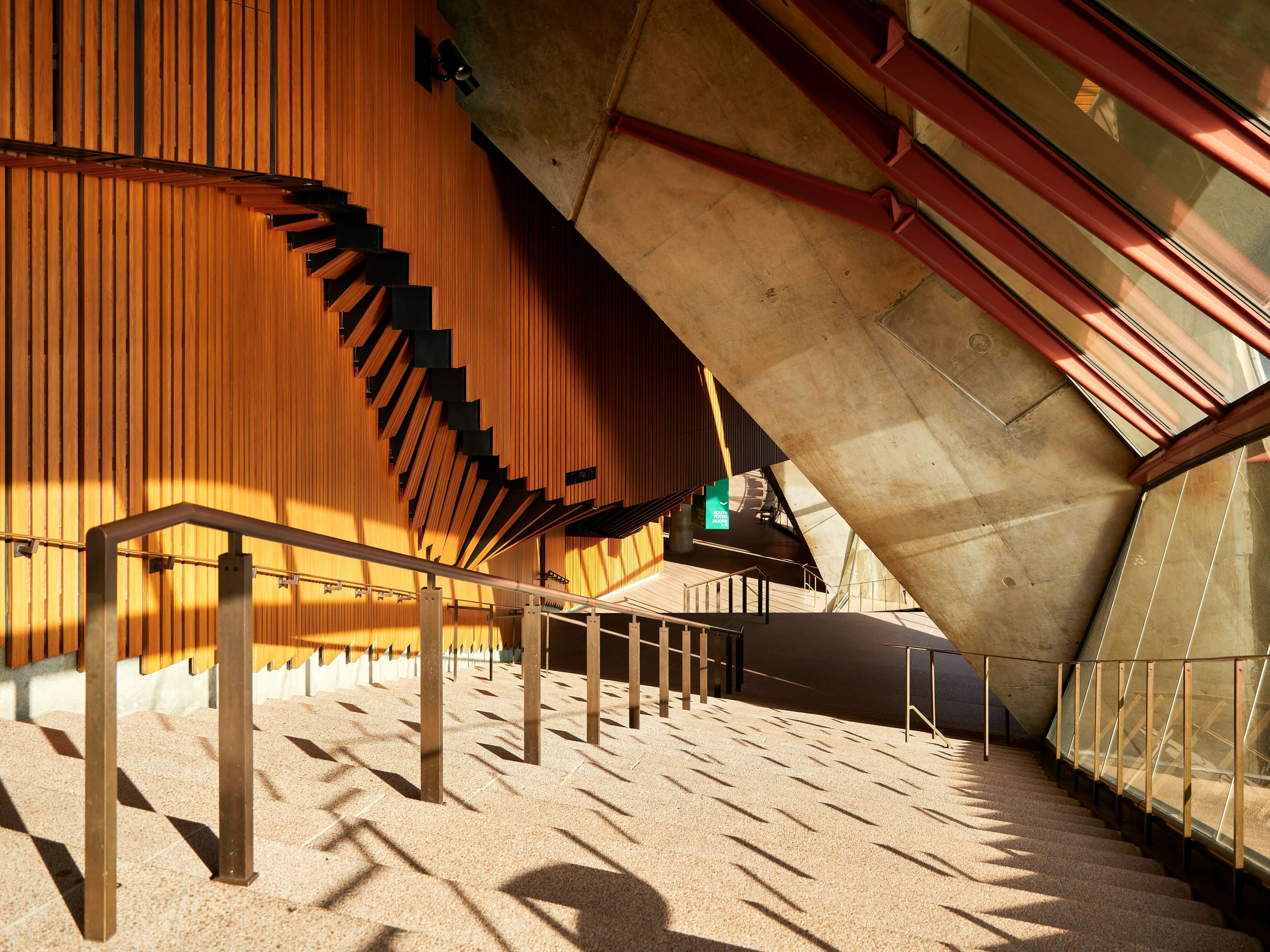
The brief was changing too. Intended uses for the performance halls had shifted, requiring new decisions around acoustics, seating, circulation and function. Hall’s team wasn’t simply completing Utzon’s drawings. They were deciding how to carry the idea forward under different conditions.
Ambitious ideas often become real by passing through other people, systems, limitations and competing priorities. By the time the building was complete, Utzon’s original idea had passed through all of them. What remained wasn’t an untouched vision, but neither was it unrecognisable.
What remained wasn’t an untouched vision, but neither was it unrecognisable.
When the Sydney Opera House finally opened in 1973, sixteen years had passed since Utzon’s competition win.
The building carries Utzon’s conception, but also Arup’s engineering, Hall’s interventions and the work of countless architects, engineers and craftspeople. Some changes enabled it to exist. Others remain contested.
The uncertainty of those sixteen years is difficult to reconcile with the coherence of what was eventually built. Solutions became part of the architecture. Compromises did too.
The process remains in the form.


